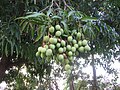
The tropical tree Mangifera indica produces a stone fruit that can be eaten. It originated from the region between northwestern Myanmar, Bangladesh, and northeastern India. M. indica has been cultivated in South and Southeast Asia since ancient times resulting in two types of modern mango cultivars: the "Indian type" and the "Southeast Asian type". Other species in the genus Mangifera also produce edible fruits that are also called "mangoes", the majority of which are found in the Malesian ecoregion.
Mango cultivars number in the hundreds all over the world. Size, shape, sweetness, color of the skin, and color of the flesh—which can be pale yellow, gold, green, or orange—depend on the cultivar of mango. Mango is the national fruit of India, Pakistan and the Philippines, while the mango tree is the national tree of Bangladesh.
Etymology
In the 16th century, the Portuguese word manga, the Malay word mangga, and finally the Tamil and Malayalam words m (meaning "mango tree") and ky (meaning "unripe fruit/vegetable") gave rise to the English word mango (plural mangoes or mangos). The scientific name, Mangifera indica, refers to a plant bearing mangoes in India.Description
Mango trees grow to 30–40 metres (98–131 feet) tall, with a crown radius of 10–15 m (33–49 ft). The trees are long-lived, as some specimens still fruit after 300 years.
The taproot descends to a depth of 6 meters (20 feet) in deep soil, where abundant, widely spaced feeder roots and anchor roots penetrate the soil deeply. The leaves are evergreen, alternate, simple, 15–35 centimeters (6–14 inches) long, and 6–16 centimeters (2+12 in.–6+12 in.) wide. When the plant is young, the leaves are orange-pink, but as they get older, they quickly turn dark, glossy red, and then dark green. The flowers are produced in terminal panicles 10–40 cm (4–15+1⁄2 in) long; each flower is small and white with five petals 5–10 millimetres (3⁄16–3⁄8 in) long, with a mild, sweet fragrance. There are over 500 known mango varieties[4], many of which ripen in the summer and yield a double crop. The fruit takes four to five months from flowering to ripening.
Size, shape, color, sweetness, and eating quality of the ripe fruit vary by cultivar. Fruits can be yellow, orange, red, or green, depending on the cultivar. The fruit has a single flat, oblong pit that can be fibrous or hairy on the surface and does not separate easily from the pulp. The fruits may be somewhat round, oval, or kidney-shaped, ranging from 5–25 centimetres (2–10 in) in length and from 140 grams (5 oz) to 2 kilograms (5 lb) in weight per individual fruit. The skin is leather-like, waxy, smooth, and fragrant, with colors ranging from green to yellow, yellow-orange, yellow-red, or blushed with various shades of red, purple, pink, or yellow when fully ripe.
Ripe intact mangoes give off a distinctive resinous, sweet smell. A single, 4–7 cm (1.6–2.8 in) long seed is encased within a thin lining that is 1–2 mm (0.039–0.079 in) thick inside the pit. The seeds of mangoes are recalcitrant and cannot withstand freezing and drying. Mango trees grow readily from seeds, with germination success highest when seeds are obtained from mature fruits.
TaxonomyMangoes originated from the region between northwestern Myanmar, Bangladesh, and northeastern India. Mango seed dispersal was once carried out by an extinct evolutionary forager, such as a megafauna mammal, which is regarded as an evolutionary anachronism. The subtropical Indian group and the tropical Southeast Asian group are the two genetically distinct populations of mangoes that emerged from their center of origin. Monoembryonic fruits are characteristic of the Indian group, whereas polyembryonic fruits are characteristic of the Southeast Asian group. It was previously believed that mangoes originated from a single domestication event in South Asia before being spread to Southeast Asia, but a 2019 study found no evidence of a center of diversity in India. Instead, it identified a higher unique genetic diversity in Southeast Asian cultivars than in Indian cultivars, indicating that mangoes may have originally been domesticated first in Southeast Asia before being introduced to South Asia. However, the authors also cautioned that the diversity in Southeast Asian mangoes might be the result of other reasons (like interspecific hybridization with other Mangifera species native to the Malesian ecoregion). Nevertheless, the existence of two distinct genetic populations also identified by the study indicates that the domestication of the mango is more complex than previously assumed and would at least indicate multiple domestication events in Southeast Asia and South Asia.
Cultivars
There are hundreds of named mango cultivars. In mango orchards, several cultivars are often grown to improve pollination. Many desired cultivars are monoembryonic and must be propagated by grafting, or they do not breed true. "The king of mangoes" is a common monoembryonic cultivar known as "Alphonso," which is an important export product. Despite their success in one climate, cultivars can fail elsewhere. For example, Indian cultivars such as 'Julie,' a prolific cultivar in Jamaica, require annual fungicide treatments to escape the lethal fungal disease anthracnose in Florida. Asian mangoes are resistant to anthracnose.
The cultivar "Tommy Atkins," a seedling of "Haden" that first ripened in 1940 in southern Florida and was initially rejected by Florida researchers for commercial use, dominates the current western market. The cultivar has been embraced by growers and importers all over the world due to its size, attractive color, shelf life, disease resistance, and transportability. Although the Tommy Atkins cultivar is commercially successful, other cultivars may be preferred by consumers for eating pleasure, such as Alphonso.
Generally, ripe mangoes have an orange-yellow or reddish peel and are juicy for eating, while exported fruit are often picked while underripe with green peels. Although producing ethylene while ripening, unripened exported mangoes do not have the same juiciness or flavor as fresh fruit.
Distribution and habitatFrom tropical Asia, mangoes were introduced to East Africa by Arab and Persian traders in the ninth to tenth centuries. The 14th-century Moroccan traveler Ibn Battuta reported it at Mogadishu. It was spread further into other areas around the world during the Colonial Era. From their colony in Goa, the Portuguese Empire introduced mangoes to East and West Africa. From the 16th to the 17th centuries, they brought it to Brazil from West Africa. By the middle to late 18th century, it had reached the Caribbean and eastern Mexico from Brazil. Mangoes were also brought to western Mexico by the Spanish Empire directly from the Philippines via Manila galleons as early as the 16th century. Mangoes were only introduced to Florida by 1833.
CultivationThe mango is now cultivated in most frost-free tropical and warmer subtropical climates. In South Asia, Southeast Asia, East and West Africa, the tropical and subtropical Americas, and the Caribbean, it is grown extensively. Mangoes are also grown in Andalusia, Spain (mainly in Málaga province), as its coastal subtropical climate is one of the few places in mainland Europe that permits the growth of tropical plants and fruit trees. The Canary Islands are another notable Spanish producer of the fruit. Other minor cultivators include North America (in South Florida and the California Coachella Valley), Hawai'i, and Australia.
Many commercial cultivars grown in Europe are grafted onto the cold-hardy rootstock of the Gomera-1 mango cultivar, originally from Cuba. Its root system is well adapted to a coastal Mediterranean climate. Many of the 1,000+ mango cultivars are easily cultivated using grafted saplings, ranging from the "turpentine mango" (named for its strong taste of turpentine) to the Bullock's Heart. Dwarf or semidwarf varieties serve as ornamental plants and can be grown in containers. Mangoes can be afflicted by a wide range of diseases.
A breakthrough in mango cultivation was the use of potassium nitrate and ethrel to induce flowering in mangoes. The discovery was made in 1974 by a Filipino horticulturist named Ramon Barba, and it was based on the original Filipino tradition of using smoke to get mangoes to flower. It allowed mango plantations to induce regular flowering and fruiting year-round. Previously, mangoes were seasonal because they only flowered every 16 to 18 months. The method is now used in most mango-producing countries.
Production
In 2023, world production of mangoes (report includes mangosteens and guavas) was 61 million tonnes, led by India with 43% of the total, and Indonesia and China as secondary producers (table).
Although the taste and texture of mangoes vary from cultivar to cultivar, they are generally sweet. Some mangoes, like Alphonso, have a soft, pulpy, and juicy texture that reminds one of an overripe plum, while others, like Tommy Atkins, are firmer and have a fibrous texture. Mango skin can be eaten raw, pickled, or cooked, but people who are susceptible to it may develop contact dermatitis of the lips, gingiva, or tongue.
The "hedgehog" style of preparation on Carabao mangoes
Alphonso mango chunks
Sliced Ataulfo mangoes
A glass of mango juice
Mango chutney
Sour unripe mangoes eaten with shrimp paste, salt, chili, vinegar or soy sauce in the Philippines
Many varieties of mango from India
Numerous cuisines include mangoes. Sour, unripe mangoes are used in chutneys (i.e., mango chutney), pickles, daals and other side dishes in Indian cuisine. A summer drink called aam panna is made with mangoes. Cooked rice can be served with mango pulp made into jelly or cooked with red gram dhal and green chilies. Mango lassi is consumed throughout South Asia, prepared by mixing ripe mangoes or mango pulp with buttermilk and sugar. Curries are also made with mature mangoes. Aamras is a thick juice made of mangoes with sugar or milk and is consumed with chapatis or pooris. Additionally, mature mango pulp is used to make mangada jam. Andhra aavakaaya is a pickle made with groundnut oil, chili powder, fenugreek seeds, mustard powder, salt, and raw, unripe, sour mango. Additionally, mango is used to make dahl and chunda, a sweet and spicy mango gratin dish. In Indonesian cuisine, unripe mango is processed into asinan, rujak and sambal pencit/mangga muda, or eaten with edible salt.
Mangoes are used to make murabba (fruit preserves), muramba (a sweet, grated mango delicacy), amchur (dried and powdered unripe mango), and pickles, including a spicy mustard-oil pickle and alcohol. Ripe mangoes are cut into thin layers, desiccated, folded, and then cut. The fruit is also added to cereal products such as muesli and oat granola.
Mango is used to make juices, smoothies, ice cream, fruit bars, raspados, aguas frescas, pies, and sweet chili sauce, or mixed with chamoy, a sweet and spicy chili paste. In Central America, mango is either eaten green, mixed with salt, vinegar, black pepper, and hot sauce, or ripe in various forms.
Mango pieces can be mashed and used as an ice cream topping or blended with milk and ice to make milkshakes. As mango sticky rice, coconut-flavored sweet glutinous rice is paired with mango slices. In other parts of Southeast Asia, mangoes are pickled with fish sauce and rice vinegar. Mango salad made with fish sauce and dried shrimp can be made with green mangoes. Mango with condensed milk may be used as a topping for shaved ice.
Mangoes can be eaten as a salad when they are raw and green. In most parts of Southeast Asia, they are commonly eaten with fish sauce, vinegar, soy sauce, or with a dash of salt (plain or spicy) – a combination usually known as "mango salad" in English.
In the Philippines, green mangoes are also commonly eaten with bagoong (salty fish or shrimp paste), salt, soy sauce, vinegar, or chilis. Mango float and mango cake, which use slices of ripe mangoes, are eaten in the Philippines. Also eaten are dried strips of sweet, ripe mango, which are sometimes combined with seedless tamarind to make mangorind. Mangoes may be used to make juices, mango nectar, and as a flavoring and major ingredient in mango ice cream and sorbetes.
Nutrition
A raw mango is 84% water, 15% carbohydrates, 1% protein, and has negligible fat (table). Raw mango provides 60 calories and is a rich source of vitamin C (40 percent of the Daily Value, DV) in a reference amount of 100 g (3.5 oz), with moderate amounts of folate (11 percent of the DV) and copper (12 percent of the DV) and low levels of other micronutrients (table).
Mango|
| Energy | 250 kJ (60 kcal) |
|---|
|
Carbohydrates | 15 g |
|---|
| Sugars | 13.7 |
|---|
| Dietary fiber | 1.6 g |
|---|
|
Fat | 0.38 g |
|---|
| Saturated | 0.092 g |
|---|
| Monounsaturated | 0.14 g |
|---|
| Polyunsaturated omega−3 omega−6 | 0.071 g 0.051 g 0.019 g |
|---|
|
Protein | 0.82 g |
|---|
|
|
| Other constituents | Quantity |
|---|
| Water | 83.5 g |
|---|
|
|
Founder & Managing Head – Plant Era
Project Lead: QR Code Tree Identification System
Agriculture Technology Innovator